
60Y Female with decreased urine output and rectal bleeding post snakebite, on haemodialysis.
July 13, 2023
Introduction: This is an online E-log Entry Blog to discuss, understand and review the clinical scenarios and data analysis of patients so as to develop my clinical competency in comprehending clinical cases, and providing evidence-based inputs.
Note: The cases have been shared after taking consent from the patient/guardian. All names and other identifiers have been removed to secure and respect the privacy of the patient and the family.
Consent: An informed consent has been taken from the patient in the presence of the family attenders and other witnesses as well and the document has been conserved securely for future references.
A 60-year-old female, who is a farmer by occupation presented with the chief complaints of vomiting and blood in stools post snakebite on 24/6/23
History of Presenting Illness:
24/06/23: Patient was apparently asymptomatic before this day. She went to visit her family's farm in the evening when she was bitten by a snake on her right ankle. Within an hour, she was taken to the hospital and was treated there for 3 days. The dead snake was identified as a Russell's Viper.
26/06/23: She was discharged on the third day. That same evening she had 5 episodes of vomiting and had 6 episodes bloody stools.
27/06/23: She was brought back to the hospital the next day and on arrival, she had facial puffiness and pain+swelling over her right ankle. She was also experiencing decreased urine output for the past 1 day.
Hospital course:
27/06/23: Patient was shifted from Emergency Medicine to GM
- Patient has severe anemia (Hb: 3.7g/dL)
- Serum Creatinine: 6.2mg/dL, BUN: 245
Nephrology consulted; suggested emergency hemodialysis with 2 units PRBC transfusion. - D-Dimer level: 5590
- Slightly deranged LFTs
- No urine output since admission.
28/06/23:
- Persistent right foot swelling. Suspected cellulitis (↑TLC)
- Elevated BUN and Cr.
- Mild hypokalemia
- Central line dialysis sheath inserted post 2D Echo (R-IJV, modified Seldinger technique)
- Patient has severe anemia and thrombocytopenia, 1 unit PRBC transfused.
- General Surgery consulted for right foot swelling and blood in stools; diagnosed with ext fissure@ 6o clock position. Suggested Sitz bath and MgSO4+glycerin dressing.
30/06/23 and 01/07/23:
- Patient was reviewed by General Surgery. Suggested treatment was continued and active ambulation was adviced.
- 1 unit PRBC transfused on 30/06/23
03/07/23:
- Fever spikes noted.
- D-Dimer level: 2080
- ↑TLC (11,200)
05/07/23:
- B/L basal crepts were noted and patient was diagnosed with a right sided pleural effusion. (CXR done)
- Down trending serum Cr and BUN
- Mild swelling over Rt foot.
06/07/23:
- Pleural effusion is now B/L. Breath sounds are decreased, with coarse crepts predominantly on the right side.
- Serum creatinine: 4.2mg/dL, BUN: 53, increased from 5/7/23.
- Minimal swelling over the right foot.
08/07/23: Patient was shifted to Nephrology.
09/07/23:
- Deranged LFTs - TB: 1.47mg/dL; ALP: 386IU/L
- Persistent B/L pleural effusion.


Russell's Viper and bite site.
History of past illness:
K/C/O Hypertension (diagnosed on arrival at the current hospital), not on medication
The patient has had increasing bloating and dyspepsia that began 9 months ago. She complains of abdominal pain that starts after a meal which has led to her avoiding food.
H/O fracture of right femur 6 years ago due to fall from standing height. (Implant present). She has occasional pain in the affected joint for which she visits her local RMP- takes unknown medication as needed (not using it currently)
H/O fracture of right humerus 15 years ago in a motor vehicle accident.
No h/o head trauma and LOC
No ENT bleed
Not a K/c/o DM, CVA, CAD,TB asthma
Medication history:
Uses unknown medication prescribed by local RMP for bloating and joint pain.
Surgical history:
Tubectomy - 20yrs ago
Personal history
Has decreased appetite that the patient attributes to bloating and reflux. She eats 2 small meals a day and occasionally drinks 1 glass of milk.
Bowel movements: 1-2/day, normal in consistency
Urine output: Decreased urine output on admission with no similar complaints in the past.
5-6 times/day as of 13/07/23, no burning on micturition.Does not drink alcohol or use tobacco in any form. No other drug use.
Food and drug allergies: No known allergies, avoids eating legumes due to the bloating.
Daily routine
Patient wakes up at 6am --> Cleans her backyard and cooks for herself. Has her first meal at 8am. Goes to visit her family farm. Has lunch at 1pm. Occasionally walks to the store in the evenings. Has dinner at 8pm and goes to bed between 9-10pm. She gets moderate exercise from her daily activities but is much more sedentary than she was 2 years ago, which she attributes to her age and decreased energy.
Family history
No similar complaints in the family.
General physical Examination
On admission:
Vitals:
Afebrile
BP: 140/80mmHg
HR: 93bpm
RR: 16cpm
SpO2: 98% on RA
GRBS: 150mg/dL
- Patient is conscious, coherent and cooperative, well oriented to time, place and person.
- Pallor present
- No signs of cyanosis, icterus, lymphadenopathy, clubbing
- Right pedal Edema+ at site of snakebite
- JVP normal

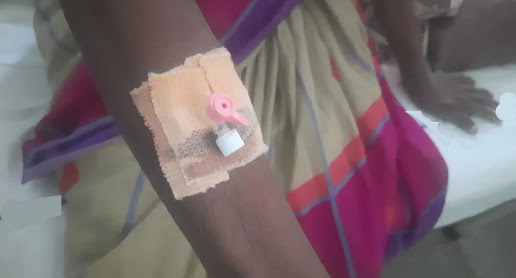
 Right IJV central line dialysis sheath
 Taken on 13/07/23: Resolved edema of the foot.
 Site of pain due to bloating

Systemic examination
Cardiovascular System: S1, S2 heard, no murmurs.
Respiratory System: BAE+, NVBS
Per Abdomen: Soft and nontender, no organomegaly.
CNS: C/C/C, AOx3, no focal neurological defects, CN function intact.
Investigations:
27/6/23:
 ECG
ECG


 28/6/23:ULTRASOUND- ABDOMEN AND PELVISImpression:2D ECHO (BEDSIDE)
- Grade I RPD changes noted in B/L kidneys
- Grade II fatty liver
Impression:- Moderate AR, Mild TR with PAH, trivial MR
- Sclerotic AV, no AS/MS
- EF=68
- Good LV systolic function
- Diastolic dysfunction +, no PE
- IVC diameter= 1.06cm


 5:17AM


 29/6/23:
 30/6/23:
4/7/23:
2D ECHO
Impression:- No RWMA
- Moderate AR, Mild TR with PAH, trivial MR
- Sclerotic AV, no AS/MS
- EF=65%
- Good LV systolic function
- Diastolic dysfunction +, no PE
- IVC diameter= 1.12cm
7/7/23:
ULTRASOUND- ABDOMEN AND PELVIS
Impression: Grade I RPD changes in B/L kidneys.Provisional diagnosis: Snake venom induced AKI on CKD with right lower limb cellulitis (resolved).
Treatment:HAEMODIALYSIS (8 sessions)BLOOD TRANSFUSION : Blood group: B+1 UNIT PRBC (28/6/23)1 UNIT PRBC (30/6/23)INJ ONDANSETRON 4MG IV STATINJ PANTOPRAZOLE 40MG IV/ODINJ OPTINEURON 10MG IN 500ML NS/IV/ODINJ LASIX 80MG IV STATINJ LASIX 40MG IV/QIDINJ CLEXANE 60MG/SC/ODINJ FONDAPARINUX 2.5MG/SC/ODINJ CALCIUM GLUCONATE 10ML IV SLOW/STATSYP POTCHLOR 10ML PO/TIDTAB ACETAZOLAMIDE 250MG PO/BIDTAB SHELCAL 500MG PO/ODTAB NICARDIPINE 10MG PO/BDINJ ERYTHROPOEITIN 4000U SC ONCE A WEEKTAB OROFER PO/ODINJ TAXIM 1G/IV/BDINJ METRONIDAZOLE 500MG/IV/TIDINJ MEROPENEM 500MG IV BD0.9% NS/ PLASMALYTE AIV FLUIDS NS @ 75ML/HRMGSO4 DRESSING WITH GLYCERINSITZ BATH





- [10.05 am, 27/06/2026] cm: Update on this patient:
Was discharged yesterday with reduced systemic envenomation and no other features suggestive of progressive envenomation. However we don't have the patient advocate's number here for further follow up as it seems that he provided a wrong number in his consent form
The other patient in the ProJR was a similar snake albeit adult and much larger, needed dialysis for her systemic envenomation.
This patient was bitten by the same variety of snake but of length 10 cm suggesting it was a juvenile and may not have injected that much venom?- This is the small snake measuring just 10 cms. Bitten by this yesterday night and presented to the casualtyAntivenom started but developed anaphylaxis with hypotensionTreated with adrenaline
The patient is currently bleeding into her skin- **### **A Re-evaluation of Clinical Heuristics in Snakebite Envenomation: A Socratic Steelman Analysis of Snake Size vs. Maturity in Russell's Viper (*Daboia russelii*)**#### **SUMMARY**Snakebite envenomation is a major global health issue where rapid clinical assessment is critical. A common clinical heuristic suggests that the size of a snake is not a reliable predictor of bite severity, with some arguing smaller snakes are more dangerous. This report uses a Socratic Steelman approach to deconstruct this "common wisdom." Through a targeted literature review prompted by a hypothetical case of a Russell's viper (*Daboia russelii*) bite, we demonstrate that while larger snakes of many species (e.g., rattlesnakes) do cause more severe envenomations, the opposite may be true for specific toxic effects of Russell's viper. Evidence shows that juvenile *D. russelii* venom, while similar in its procoagulant effects to adult venom, contains a higher proportion of enzymatic proteins that lead to more severe nephrotoxicity. This analysis refutes the simple "size doesn't matter" heuristic and replaces it with a more nuanced, species-specific clinical guideline: for Russell's viper, snake maturity is a critical predictor of the *type* of systemic toxicity, with juvenile bites warranting heightened suspicion for acute kidney injury.**Keywords:** Snakebite, Envenomation, *Daboia russelii*, Russell's Viper, Ontogenetic Variation, Clinical Reasoning, Evidence-Based Medicine, Acute Kidney Injury (AKI).---#### **I. INTRODUCTION**A 50-year-old female presents to a rural clinic in Telangana, India, after being bitten on the toe by a "small, thin" snake identified by locals as a Russell's viper (*Daboia russelii*). Initial assessment reveals local swelling and a prolonged 20-minute whole blood clotting time (20WBCT), confirming systemic envenomation. The treating clinician, recalling the common clinical pearl that "small snakes can be more dangerous," is faced with a critical question: Does the snake's apparent immaturity alter the clinical prognosis or management priorities?Traditional clinical wisdom is divided. One long-held belief is that snake size is an unreliable indicator of severity. An opposing view, often taught to junior clinicians, is that smaller or juvenile snakes are more dangerous due to factors like excitability or an inability to "meter" their venom dose. This case report uses this clinical scenario to launch a Socratic Steelman analysis—a method of strengthening the initial heuristic to its most robust form before systematically dismantling it with evidence—to arrive at a more precise, evidence-based clinical model for assessing snakebite severity.#### **II. METHODS: A SOCRATIC STEELMAN APPROACH**To address the clinical question, we first constructed the strongest possible argument (a "Steelman") for the initial hypothesis that snake size is not a reliable positive predictor of severity and that smaller snakes may be more dangerous.**The "Steelman" Hypothesis:**1. **Behavioral Argument:** Smaller, juvenile snakes may be more aggressive or nervous, leading to multiple strikes or a more complete discharge of their venom glands.2. **Venom Metering Argument:** Juvenile snakes may lack the developed musculature or experience for "venom metering," causing them to inject their entire venom load in a defensive bite, unlike larger snakes which may conserve venom.3. **Compositional Argument:** The venom of juvenile snakes may be compositionally different and more potent, designed to subdue smaller, faster prey, with unintended toxic consequences in humans.4. **Cognitive Bias Argument:** Focusing on a "large" snake as being more dangerous creates a significant risk of under-triaging and under-treating bites from "small" snakes, making the heuristic itself dangerous.**The Socratic Inquiry:**A targeted literature search of the PubMed database was conducted to find evidence that could challenge or validate these four pillars of the Steelman argument. Keywords included "snakebite severity," "snake size," "ontogenetic variation," "Daboia russelii," and "juvenile venom."#### **III. RESULTS: EVIDENCE FROM THE LITERATURE**The literature search revealed a nuanced reality that varies significantly by snake species.* **General Finding (Non-Russell's Vipers):** For many vipers, particularly in the Americas (e.g., rattlesnakes, *Bothrops*), the evidence directly contradicts the Steelman hypothesis. Multiple studies confirm that **larger snakes are statistically associated with more severe envenomations**, higher antivenom requirements, and longer hospital stays. This is attributed to a larger venom gland and the ability to inject a greater absolute volume of venom, invalidating the behavioral and metering arguments (Pillars 1 & 2) for this group.* **Specific Finding (Russell's Viper):** The data for *Daboia russelii* is more complex and directly addresses the Compositional Argument (Pillar 3).* **Coagulopathy:** One 2022 study found that the in-vitro procoagulant potency on human plasma was **similar** between adult and neonate *D. russelii* venom. Furthermore, commercial antivenom was equipotent in neutralizing this effect from both age groups. (PMID: 34752826)* **Nephrotoxicity:** A separate 2022 study on *Daboia siamensis* (Eastern Russell's viper) revealed a critical ontogenetic shift. Compared to adult and subadult venom, **juvenile venom possessed significantly higher levels of phospholipase A₂, metalloproteinase, and other enzymatic proteins.** In animal models, this compositional difference resulted in **markedly greater nephrotoxicity** and higher tubulonephrosis lesion scores. (PMID: 35432494)#### **IV. DISCUSSION: DECONSTRUCTING THE HEURISTIC & REFINING THE MODEL**The evidence allows us to deconstruct the initial Steelman heuristic. While the Cognitive Bias Argument (Pillar 4) remains valid—all snakebites must be treated as serious—the underlying reasoning is flawed. The relationship between snake maturity and danger is not a simple inverse correlation; it is a complex, species-specific shift in pathophysiology.For Russell's viper, the clinical danger pivots not just on venom *quantity* but on venom *composition*. The juvenile's venom, while not necessarily more procoagulant, is significantly more nephrotoxic. An adult can cause severe consumptive coagulopathy due to a large venom dose, while a juvenile can precipitate acute kidney injury (AKI) with a much smaller total venom load due to its specific enzymatic makeup.This leads to a new, more refined clinical heuristic:**A Proposed Evidence-Based Model for Russell's Viper Envenomation:**1. **Universal Triage:** All *Daboia* bites are high-risk medical emergencies.2. **Maturity as a Diagnostic Clue:** The observed size/maturity of the snake is a critical piece of clinical data that should be actively sought.3. **Bite from Adult/Large Snake:** Prioritize management of severe coagulopathy. Expect a potentially large venom volume and higher antivenom requirement.4. **Bite from Juvenile/Small Snake:** While managing coagulopathy, maintain an extremely high index of suspicion for **Acute Kidney Injury (AKI)**. Initiate aggressive hydration and frequent renal function monitoring (e.g., urine output, creatinine) from the moment of presentation, even if coagulation parameters are only mildly deranged.**Conclusion:** The Socratic Steelman analysis successfully transformed a vague and partially incorrect clinical pearl into a precise and actionable, evidence-based guideline. For the patient in our introductory scenario, the observation of a "small, thin" viper is not a reason for reassurance, nor is it a simple indicator of "more danger." It is a specific warning sign to prioritize the surveillance and prophylactic management of impending renal failure.
- More data available in the below link 👇


No comments:
Post a Comment